Tuesday, September 25, 2012

Number 50: Roman Slave Shackle


Iron shackle, likely for harnessing slaves, which dates to Roman times. It was found in Headbourne Worthy in Hampshire.

                                                     Photo Credit Portable Antiquities scheme

Number 49: Hockley Pendant


This is an attractive and finely carved gold reliquary pendant from Hockley in Essex. On one face is an image of the Virgin Mary carrying the cross, while the other features a representation of the blood of Christ. Around the four sides are inscribed the names of the Three Magi. The pendant features a sliding lid, which would have granted access to a relic.


Photo Credit Portable Antiquities Scheme

Number 48: Epsom Horse Harness


Recently found in a field in Surrey, this item is a gilded copper-alloy horse boss (a decorative fitting for a horse's harness) featuring the royal coat-of-arms of the House of Stuart. It is almost certainly from one of the king's own horses, and can be dated by the coincidence of its discovery at the Durdens, an estate belonging to the Berkeley family, visited at least twice by Charles II in the 1660s.

Photo Credit Portable Antiquities Scheme

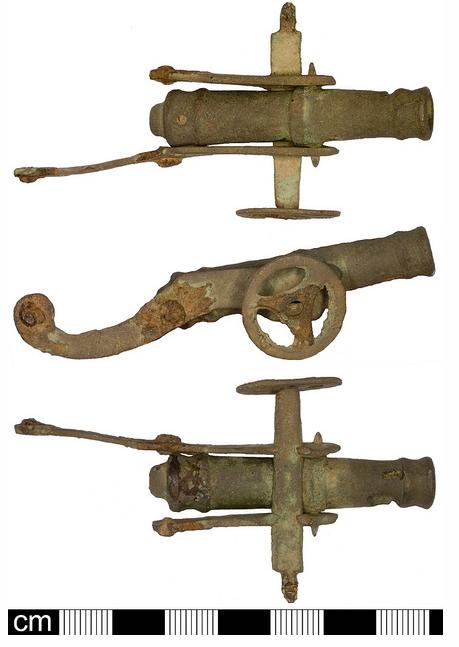
Number 47: Pitminster Toy Cannon


This is a fabulous example of a child's toy cannon from the 18th Century. Though the copper-alloy item is missing one wheel and the carriage is incomplete, it is still possible to appreciate the remarkable realism with which this was constructed. It may well have been intended to fire real 'cannonballs' using gunpowder!


Photo Credit Portable Antiquities Scheme

Number 46: The Sedgeford torc terminal


A badly damaged gold torc, or necklace, dating to the Iron Age, this item was found in two pieces, on two separate occasions, almost 50 years apart. It appears to have suffered damage from a plow, resulting in the separation of one terminal and the unravelling of the many gold wires that make it up.

Photo Credit Portable Antiquities Scheme

Number 45: A medal from World War One


George Humber's Distinguished Conduct Medal for service in the First World War was found in Limpsfield, Surrey, just outside the M25. Thankfully the finder, Manuel Nicdao, reported it to his Finds Liaison Officer David Williams, who researched Sjt. Humber's story. George Humber was born and died on the Isle of Wight, and so it was agreed to advertise the find in a local paper in an appeal to locate his living relations. Thankfully Mr Humber's family was located and contacted by Frank Basford, the Finds Liaison Officer for the Isle of Wight, and Mr Nicdao was able to pass on the medal to them.

Photo Credit Portable Antiquities Scheme

Number 44: Rochester Cuff-link


This small item, a single silver cuff link button featuring a design of two hearts under a crown, sparked the reporting of over 150 similar styled cufflinks subsequent to its discovery in 2001. They are all decorated with variations on a theme that is believed to relate to the marriage of King Charles II to Catherine of Braganza (Portugal) in 1662. It is now in the collection of the British Museum. 

Photo Credit Portable Antiquities Scheme

Number 43: Tanworth Comb


An Iron Age cast copper alloy comb. The comb is a sub-rectangle in plan. One long edge is convexly curved, forming the upper edge of the comb. The upper surface of both sides of the comb is decorated. 

Photo Credit Portable Antiquities Scheme

Number 42: A figurine of Cautopates


This very evocative figurine found in Newton Kyme, North Yorkshire, is a representation of an attendant of the Roman deity Mithras. The Mithraic cult was popular amongst soldiers in the later Roman Empire.

Photo Credit Portable Antiquities Scheme
Number 41: Cloth seal assemblage


The collection of lead cloth seals found in the River Wear in Durham add greatly to the corpus of information about these items. The condition of these items deteriorates rapidly and precise identification and dating can be difficult.

Photo Credit Portable Antiquities Scheme

Number 40: Putney 'Brothel Token' or Spintria

A copper-alloy disc featuring the number XIIII on the reverse and an image of a couple in a sexual embrace on the obverse, found on the banks of the River Thames in Putney. It remains undecided as to whether this is an actual token, used to pay for the services of a Roman prostitute, or just a raunchy gaming counter. Either way, it is an incredibly rare find from Britain's Roman past. The finder, Regis Curson, has generously donated the item to the Museum of London.

Photo Credit Portable Antiquities Scheme

Number 39: Beddingham Nose


This piece of sculpted copper-alloy found in Beddingham, East Sussex, is most likely a prosthesis dating from the 16th or 17th Centuries. If so, it would have been worn to hide its owner's facial disfigurement, most likely resulting from a disease such as syphilis, though possibly suffered in an accident.

Photo Credit Portable Antiquities Scheme

Number 38: A hoard of Spanish Dubloons


The gold coins recorded here, found in 2010 and 2011 in South East Lincoln, are actually addenda to an original hoard of coins found in the same place in 1928. Some of the original coins were acquired by the British Museum after being declared Treasure Trove. They are all 8-escudos coins (technically it was the 2-escudos coin that was termed a 'doubloon') and were the largest gold coins of the Spanish colonies at the time. It is intriguing to wonder how they ended up being buried near the city of Lincoln in the early 1800s.


Photo Credit Portable Antiquities Scheme

Number 37: Anarevitos gold stater


A single gold stater (coin) dating to the late Iron Age. It was found near Dover in Kent in 2010 and features the inscription 'ANAREVITO' - the name of a previously unknown ruler. Interestingly, on the obverse there is an inscription of a second ruler who is already familiar to us from other coins - Eppilus.


Photo Credit Portable Antiquities Scheme

Number 36: Langstone Hoard


Large Iron Age wooden tankard found close to, but not a direct component of, a hoard of copper-alloy vessels from the edges of a marshy land outside of Newport, Wales

                                                     Photo Credit Portable Antiquities Scheme

Number 35: Durham assemblage


A copper-alloy Roman figurine dating to the first to third centuries AD. The figurine is that of a naked Cupid in a flying pose.


Photo Credits Portable Antiquities Scheme


Number 34: Gold Amulet


This Romano-British object, a lamella, is a thin gold sheet measuring just 4cm x 3cm which is inscribed with magical symbols and Greek and Latin characters. It would have originally been folded tightly and held in a narrow diameter cylinder, worn on its owner's person. It is likely to date to the first or second century AD

Photo Credit Portable Antiquities Scheme

Number 33: Llanbedrgoch Artefacts


The hacksilver items recorded here are a small sample of the many and various items from the Viking period which have been discovered in Llanbedrgoch on the Isle of Anglesey over the last 20 years. 


Photo Credit Portable Antiquities Scheme

Number 32: The Hackney Hoard


A group of 80 gold American $20 Double Eagle coins, found in a glass Kilner jar in a back garden in Hackney, Greater London, in 2007. The coins date from 1854 to 1913 and the reason for their burial was a mystery until local man Stephen Selby found evidence for an earlier discovery of coins of the same type, in the same place, 55 years earlier.

Photo Credit Portable Antiquities Scheme

Number 31: Witch-bottle


This is the bottom half of an approximately 6cm diameter green bottle from the early 19th century that contained small iron and bronze objects and a piece of leather. Originally it would have contained human hair and urine. It is representative of a series of objects dating from throughout the post-medieval period which are generally believed to be 'witch bottles'. They were intended to protect the residence where they were buried from evil spells cast by witches on the inhabitants. The witch bottle and its contents are now in the Museum of Lincolnshire Life.


Photo Credit Portable Antiquities Scheme